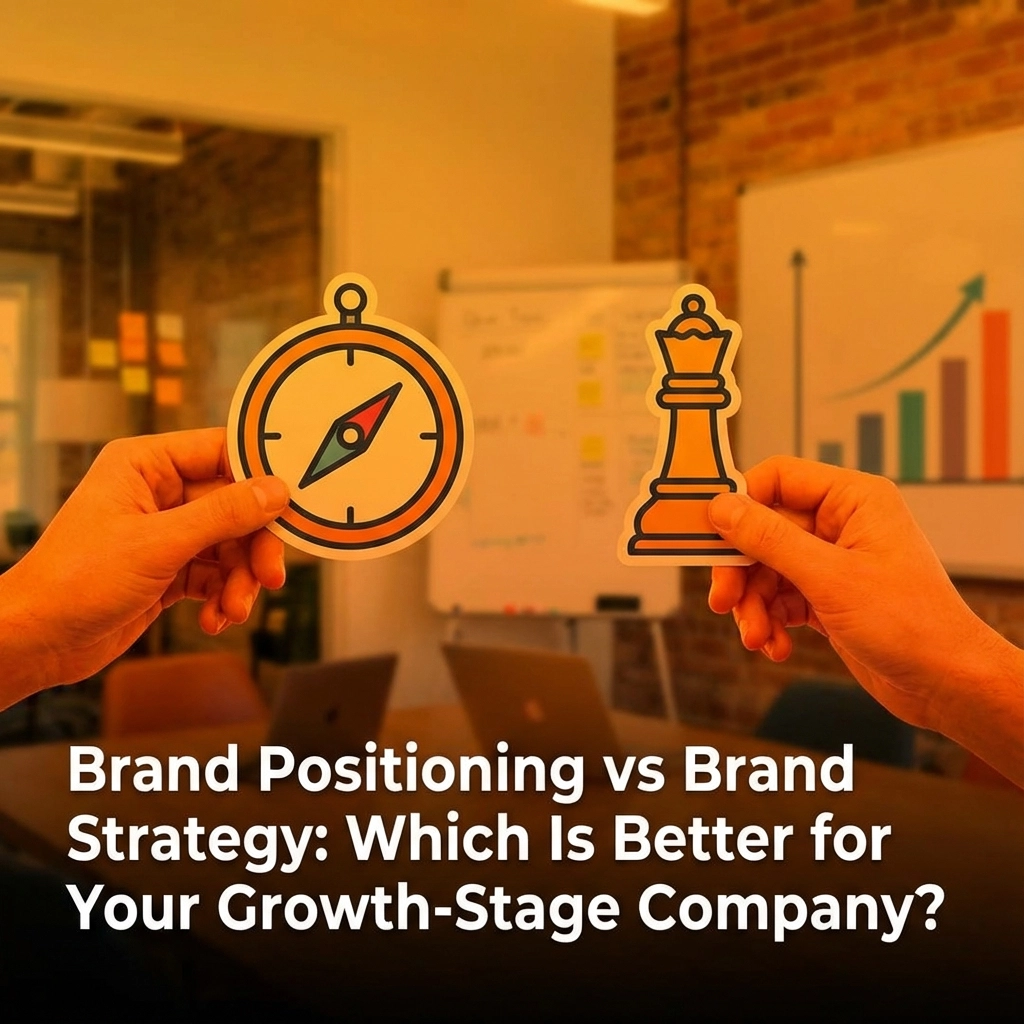
Growth-stage founders ask this question constantly: Should we focus on brand positioning or brand strategy first? The question itself reveals a fundamental misunderstanding that costs companies millions in wasted marketing spend and missed opportunities.
The truth: Brand positioning and brand strategy aren’t competing priorities: they’re interdependent systems that must work together to drive sustainable growth.
Here’s how to get both right for your growth-stage company.
What Brand Strategy Actually Means
Brand strategy is your analytical foundation. It defines the “why” and “what” of your brand’s existence through data-driven decisions about:
- Mission and vision statements that guide internal decision-making
- Core values that shape company culture and customer relationships
- Target audience definition based on market research and customer data
- Competitive analysis that identifies market gaps and opportunities
- Long-term business objectives tied to measurable growth metrics
Think of APPLE’s brand strategy: “Think Different” wasn’t just a tagline: it represented a strategic commitment to innovation-first product development, premium pricing models, and customer experience excellence that guided every business decision for decades.
Results: APPLE’s strategic consistency delivered 25% average annual revenue growth from 1997-2021, transforming a near-bankrupt company into the world’s most valuable brand.

Photo by campaign creators on Unsplash
What Brand Positioning Actually Delivers
Brand positioning is your creative execution engine. It answers the “how” of your market presence by establishing the unique mental space your brand occupies in customers’ minds relative to competitors.
Effective positioning defines:
- Unique value proposition that differentiates you from alternatives
- Emotional connection points that drive customer loyalty
- Messaging frameworks that ensure consistent communication across all touchpoints
- Visual identity systems that reinforce brand recognition
- Competitive differentiation that justifies premium pricing or market share capture
Consider TESLA’s positioning: “Sustainable luxury performance.” This positioning enabled TESLA to charge premium prices while building a waitlist of customers eager to buy electric vehicles: despite established automakers offering similar technology at lower prices.
Impact: TESLA captured 17% of the luxury car market within five years, generating $96.77 billion in 2023 revenue.
Why Choosing Between Them Kills Growth
The “brand positioning vs brand strategy” debate creates a false dichotomy that undermines both efforts. Here’s what happens when companies treat them as separate initiatives:
Strategy without positioning: Your brand becomes analytically sound but emotionally hollow. Customers understand what you do but feel no compelling reason to choose you over alternatives. Internal teams have clear objectives but struggle to communicate value propositions effectively.
Positioning without strategy: Your brand generates initial interest but lacks sustainable differentiation. Marketing campaigns produce short-term engagement spikes followed by customer churn. Growth initiatives conflict with each other because there’s no unified foundation guiding decisions.
Real example: A fintech startup we analyzed spent $2.3 million on positioning-focused marketing campaigns while neglecting strategic foundation work. Results: 847% increase in website traffic but only 12% conversion rate improvement and 156% customer acquisition cost increase over 18 months.

Photo by austin distel on Unsplash
The Growth-Stage Decision Framework
Growth-stage companies need both brand strategy and positioning working in concert. Use this framework to determine priority and sequencing:
Start with Strategy If:
- Your company lacks clear market differentiation beyond product features
- Internal teams disagree about target customers or core value propositions
- Customer acquisition costs exceed industry benchmarks by 40%+ consistently
- Revenue growth fluctuates wildly without clear seasonal or market explanations
- Competitive pressure increases but you struggle to articulate unique advantages
Lead with Positioning If:
- Your strategy foundation is solid but market perception doesn’t match reality
- Competitors dominate messaging in your category despite inferior offerings
- Sales teams report consistent customer confusion about your differentiation
- Marketing campaigns generate awareness but fail to drive qualified leads
- Brand recognition lags significantly behind customer satisfaction scores
Prioritize Both Simultaneously If:
- You’re preparing for Series B+ funding where brand equity impacts valuation
- Market expansion requires entering new geographic or demographic segments
- Competitive landscape shifts dramatically due to new entrants or technology changes
- Customer expectations evolve rapidly in your industry vertical

Photo by Campaign Creators on Unsplash
Industry-Specific Implementation Examples
Healthcare Technology
Strategy focus: Regulatory compliance, patient privacy, clinical efficacy data
Positioning focus: Trust-building, outcome-focused messaging, practitioner endorsements
Example: TELADOC combined strategic HIPAA compliance investments with positioning as “healthcare access democratization” to achieve 38% year-over-year growth and $2.4 billion market cap increase.
Consumer Products
Strategy focus: Supply chain optimization, retail partnership development, customer lifetime value
Positioning focus: Emotional connection, lifestyle integration, social media presence
Example: ALLBIRDS aligned sustainable materials strategy with “comfortable sustainability” positioning to capture 3.2% of the premium sneaker market within four years.
Financial Services
Strategy focus: Security infrastructure, regulatory relationship management, scalable technology platforms
Positioning focus: Accessibility, transparency, customer empowerment messaging
Example: ROBINHOOD’s commission-free trading strategy supported “democratize finance” positioning, resulting in 22.5 million active users and $7.86 billion IPO valuation.
Cultural/Creative Industries
Strategy focus: Community building, content creation scalability, audience development
Positioning focus: Authenticity, cultural relevance, creator economy participation
Example: PATREON combined creator-first platform strategy with “creator independence” positioning to process $2+ billion in creator earnings and maintain 68% market share in creator subscription services.
Implementation Timeline for Growth-Stage Companies
Months 1-3: Foundation Development
- Conduct strategic brand audit including competitor analysis, customer research, internal stakeholder interviews
- Define core strategy elements with measurable objectives and success metrics
- Develop positioning framework that translates strategy into market-ready messaging
- Create brand guidelines that ensure consistent execution across all touchpoints
Months 4-6: Market Testing and Refinement
- Launch pilot campaigns testing positioning effectiveness with target audiences
- Gather quantitative feedback through A/B testing, conversion tracking, customer surveys
- Refine messaging based on data while maintaining strategic consistency
- Scale successful positioning elements across larger marketing initiatives
Months 7-12: Full Implementation and Optimization
- Deploy integrated brand strategy across all customer touchpoints and internal communications
- Monitor competitive response and adjust positioning to maintain differentiation
- Measure long-term impact on customer acquisition costs, lifetime value, brand recognition
- Plan annual strategy review to maintain alignment as market conditions evolve

Photo by you x ventures on Unsplash
Measuring Success: Key Performance Indicators
Strategic Success Metrics:
- Customer acquisition cost decreases 25-40% within 12 months
- Customer lifetime value increases 30-60% as brand recognition improves
- Internal team alignment scores improve measurably through employee surveys
- Competitive win rate increases in head-to-head sales situations
Positioning Success Metrics:
- Brand awareness grows 50-100% in target demographics within 6 months
- Message recall testing shows 40%+ improvement in key value proposition recognition
- Social media engagement increases 75-150% without proportional ad spend increases
- Sales cycle length decreases as positioning clarifies customer decision-making
Common Implementation Mistakes to Avoid
Treating strategy and positioning as sequential rather than iterative processes. Both evolve based on market feedback and should inform each other continuously.
Delegating brand work entirely to external agencies without maintaining internal strategic oversight and cultural alignment.
Focusing exclusively on external positioning while neglecting internal culture and employee brand experience that customers inevitably encounter.
Changing positioning frequently without allowing sufficient time for market recognition and customer habit formation to develop.
Ignoring competitive responses that can neutralize positioning advantages if left unaddressed for extended periods.

Photo by medienstürmer on Unsplash
The most successful growth-stage companies recognize that brand positioning and brand strategy are complementary investments that compound over time. Companies like STRIPE, NOTION, and FIGMA didn’t choose between strategic foundation and market positioning: they developed both simultaneously to create sustainable competitive advantages that continue driving growth today.
The bottom line: Stop asking which is better. Start asking how to make both work together for your specific growth objectives and market realities. That’s where real competitive advantage lives.
Need help developing integrated brand strategy and positioning for your growth-stage company? Prototype MKTG specializes in creating aligned brand systems that drive measurable results across consumer, healthcare, tech, fintech, and cultural sectors.