If you’re a founder or part of a lean startup team, you already know the “spaghetti at the wall” feeling. One day you’re told you need to be on TikTok; the next, you’re hearing that SEO is the only way to survive. You try a little bit of everything, get exhausted, and then wonder why your lead count hasn’t moved an inch.
The problem isn’t your product, and it’s usually not even your effort. It’s your lack of a system.
Most traditional agencies want to sign you to a six-month retainer and spend the first 90 days “onboarding” while charging you five figures. At Prototype MKTG Studio, we think that’s a bit much. You need momentum, not a mountain of paperwork. Building a marketing system doesn’t require a 20-person department; it requires a repeatable framework that turns effort into measurable growth.
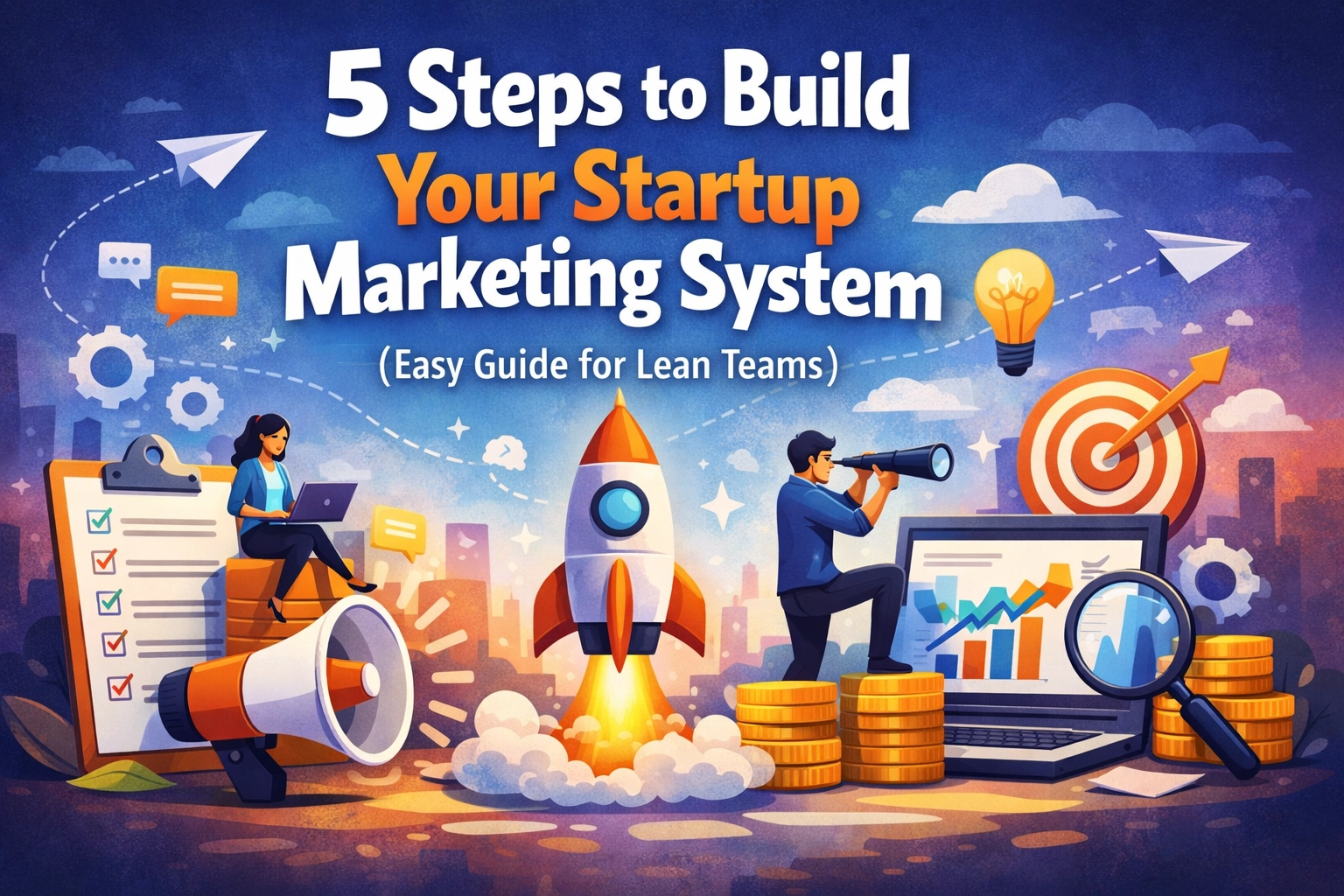
Here is the 5-step guide to building a marketing system that actually works for lean teams.
Step 1: Establish Strategic Ownership (The “Who” and “Why”)
Before you post a single post or run a Google Ad, someone has to own the vision. In a lean team, this is often the founder, but it could be a dedicated marketing manager or a trusted partner.
The biggest mistake startups make is “outsourcing the thinking.” You can outsource the execution, but the strategy, the core message of why your product exists and who it’s for, must be clear. Without a navigator, the fastest ship in the world will just go in circles.
How to do it:
- Define your “One Big Goal”: Is it 50 new signups a month? Is it $10k in MRR? Pick one metric to rule them all.
- Identify your Ideal Customer Profile (ICP): If you’re talking to everyone, you’re talking to no one. Get specific.
- Audit your current state: What’s working? What’s a total waste of time? Be brutal.
At Prototype MKTG Studio, we focus on clear, fixed-scope services because we know lean teams don’t have time for “fluff.” We help you lock in that direction so every dollar spent is moving you toward your specific goal.

Step 2: Organize Around High-Impact Sprints
The days of the “yearly marketing plan” are over. For a startup, a year is a lifetime. Instead, you need to think in sprints.
A sprint is a short, focused burst of work, usually two to four weeks, where you tackle a specific set of high-impact tasks. This prevents “shiny object syndrome.” If a new social media trend pops up in the middle of your SEO sprint, it goes in the “backlog” for later. You finish what you started first.
The Sprint Workflow:
- The Backlog: List every marketing idea you have.
- The Selection: Pick the top 2-3 items that will actually move the needle this month.
- The Execution: Focus only on those items.
- The Review: At the end of the sprint, look at the data. Did it work? If yes, keep doing it. If no, pivot.
This agile approach is exactly how we structured our services. By focusing on fixed-scope deliverables, we help you complete a “sprint” without the overhead of managing a full-time creative team.
Step 3: Build Systems, Not Just Headcount
Scale comes from processes, not just adding more people to the payroll. If your marketing breaks the moment a team member takes a vacation, you don’t have a system; you have a dependency.
Lean teams win by using tools and templates to do the heavy lifting. You want a “Marketing Machine” where you can plug in content and get results out the other side.
Essential components of your machine:
- Content Calendar: A centralized place where all your posts, blogs, and emails live. No more “What should we post today?” panic at 9:00 AM.
- Marketing Automation: Use tools to handle lead scoring, welcome emails, and follow-ups. Let the robots do the repetitive stuff.
- Standard Operating Procedures (SOPs): Document how you do things. How do you upload a blog? How do you track a lead? Write it down so anyone can do it.
One of the reasons founders love our model is the transparency. There’s no guessing game about what you’re paying for or how it’s being done.

Step 4: Implement Daily Accountability
In a lean team, it’s easy for marketing to slip to the bottom of the to-do list because “product” or “customer support” feels more urgent. To build a system, marketing must be a daily habit.
You don’t need three-hour meetings. You need Daily Standups.
Take 15 minutes every morning to answer three questions:
- What did I do yesterday to grow the business?
- What am I doing today?
- Is anything blocking me?
This keeps the momentum alive. If you realize you haven’t done anything for your marketing sprint in three days, the daily standup will highlight that real fast. It creates a culture of execution rather than just “planning to plan.”
Step 5: Make Data-Driven Decisions (And Stop Guessing)
The final step in your marketing system is the feedback loop. You need to know if your system is actually working. Many founders get overwhelmed by “vanity metrics”: things like likes, follows, or impressions. While those are nice, they don’t pay the bills.
Focus on KPIs (Key Performance Indicators) that tie directly to revenue.
What to track:
- Cost Per Acquisition (CPA): How much does it cost to get one new customer?
- Conversion Rate: Of the people who visit your site, how many actually take action?
- Customer Lifetime Value (CLV): How much is a customer worth over time?
By reviewing these numbers at the end of every sprint, you can iterate. Maybe your Facebook ads aren’t working, but your email newsletter is crushing it. A system allows you to see that clearly, so you can stop wasting money on the losers and double down on the winners.

Why a “System” Beats an “Agency”
Most startups don’t need a traditional agency relationship. They need a partner who can help them build their own internal momentum.
Traditional agencies thrive on complexity. They want to make marketing seem like a dark art that only they can perform. But at Prototype MKTG Studio, we believe marketing should be clear. Our fixed-scope services are designed to fit perfectly into the “sprint” model mentioned in Step 2. We provide the expertise and the deliverables you need to keep your system running, without the long-term commitment or the “black box” reporting.
Building a startup is hard enough. Your marketing shouldn’t be the thing that keeps you up at night. By establishing ownership, working in sprints, building repeatable processes, staying accountable, and following the data, you can build a marketing system that grows as fast as you do.
Ready to stop the guesswork and start building momentum? Let’s get to work. Whether you need a full SEO overhaul or a streamlined social strategy, Prototype MKTG Studio is here to help you build a system that scales.
Key Takeaways for Lean Teams:
- Strategy First: Don’t execute until you know your “Who” and “Why.”
- Sprints over Marathons: Work in 2-4 week cycles to stay agile.
- Automate Everything: Use tools to replace manual labor where possible.
- Check-in Daily: 15 minutes of accountability saves hours of wasted time.
- Follow the Money: Ignore vanity metrics; focus on what drives revenue.
By Phaon K. Spurlock, MBA, Founder